

The territory

The territory

One of the most picturesque corners of Umbria

Monteleone di Spoleto lies geographically in the Alta Valle del Corno, in a suggestive area full of natural beauties and important for the species of flora and fauna present. These aspects are the setting for one of the most picturesque corners of Umbria, rich in history and traditions, thanks to the presence of man since the time of the Italic peoples.

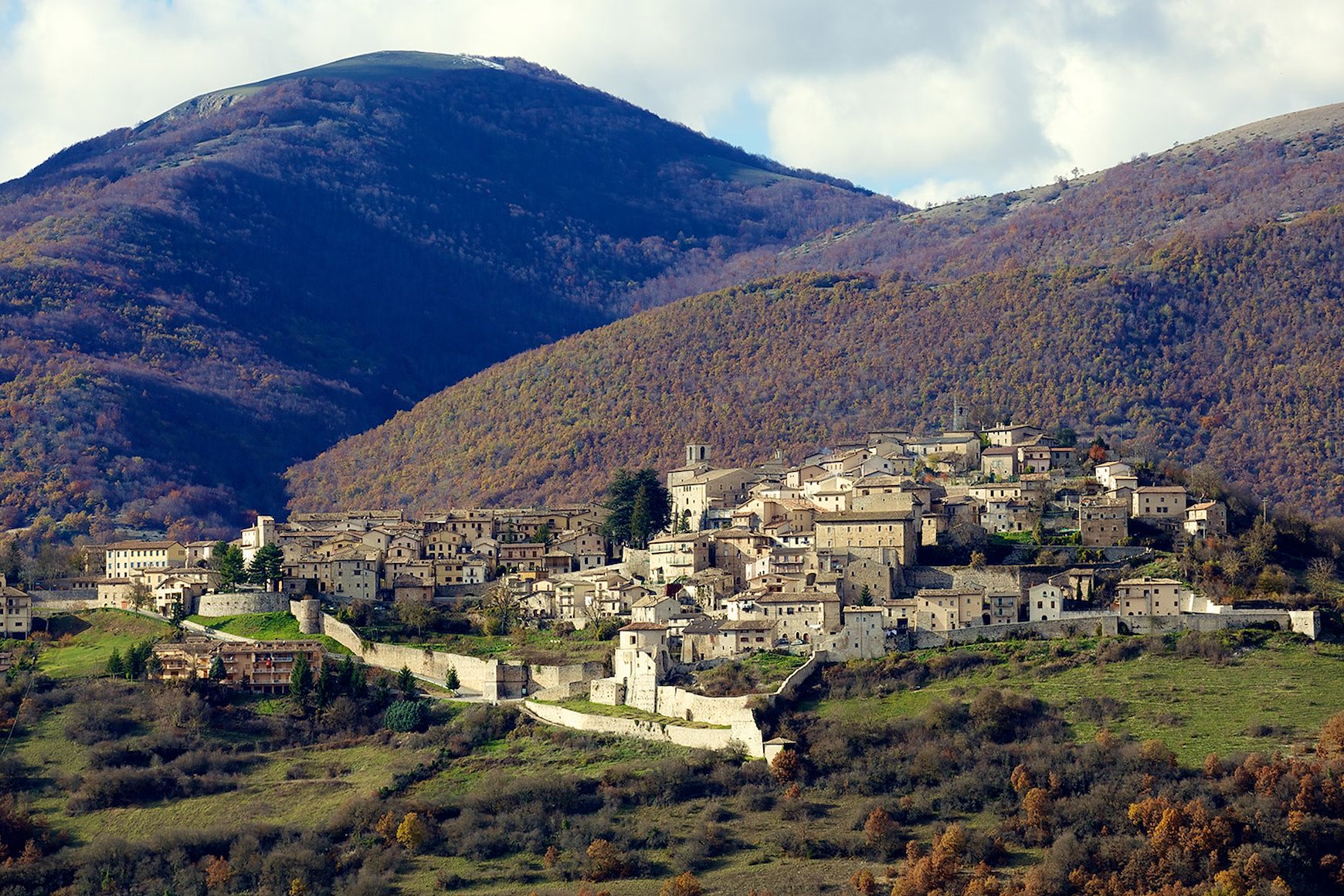
The territory of Monteleone di Spoleto is mostly mountainous and is characterized by two landscape units: the first consists of the mountains of the dorsal Coscerno Mount – Aspra Mount west and Cornuvolo Mount east, the second is made up of sub flat units where the rivers flow, such as Corno River which is the main river. The limestone reliefs have rather large tops and steep slopes (picture 1); the highest peak, located southwest of Monteleone, is Aspra Mount 1654 mt. a.s.l. The Corno River has an overall length of 56 km and is the left tributary of Nera River. The substrate on which it slides is characterized by the prevalence of calcareous soils with high permeability and only on small extensions (less than 15% of the total) are present soils with low permeability.

Geology of the territory

The morphogenetic processes that gave rise to the basin of Leonessa date back to the Lower and Middle Pleistocene (1.8 million years ago), thanks to the discovery of some mammalians (remains of elephants) and shellfish of fresh water of Galeriano within fluvial-lake sediments that characterized the area. Then the basin was drained by an outflow due to a new tectonic phase, which originated a morphology of the landscape not much different from today's one. It is therefore clear that the territory of Monteleone di Spoleto is characterized by a continuous geological and geo-morphological evolution.

The history of these mountains began about 200 million years ago, in the Jurassic Period. It is interesting to emphasize that in the territory of Monteleone di Spoleto there are the limestone rocks of the Stratification of Umbria-Marche, which was formed in the marine environment and sometimes rich in fossils (ammonites, gastropods, bivalves, crinoids, foraminifera, etc.) ranging from the Lower Jurassic (about 200 million years ago) until the Paleogene period (10 million years ago). The fossil remains that are found in these rocks allow us to reconstruct the period in which they were formed. From this, we know that about 200 million years ago, also in this area there was an environment similar to that of the current Bahamas, with coral islands, warm and shallow sea. Subsequently the seabed became deeper though rather irregular with ups and downs structures, which were soon smoothed out by the limestone sediments that were deposited on the seabed.

Last updated:: 2/9/2026 3:38:39 PM