

Description
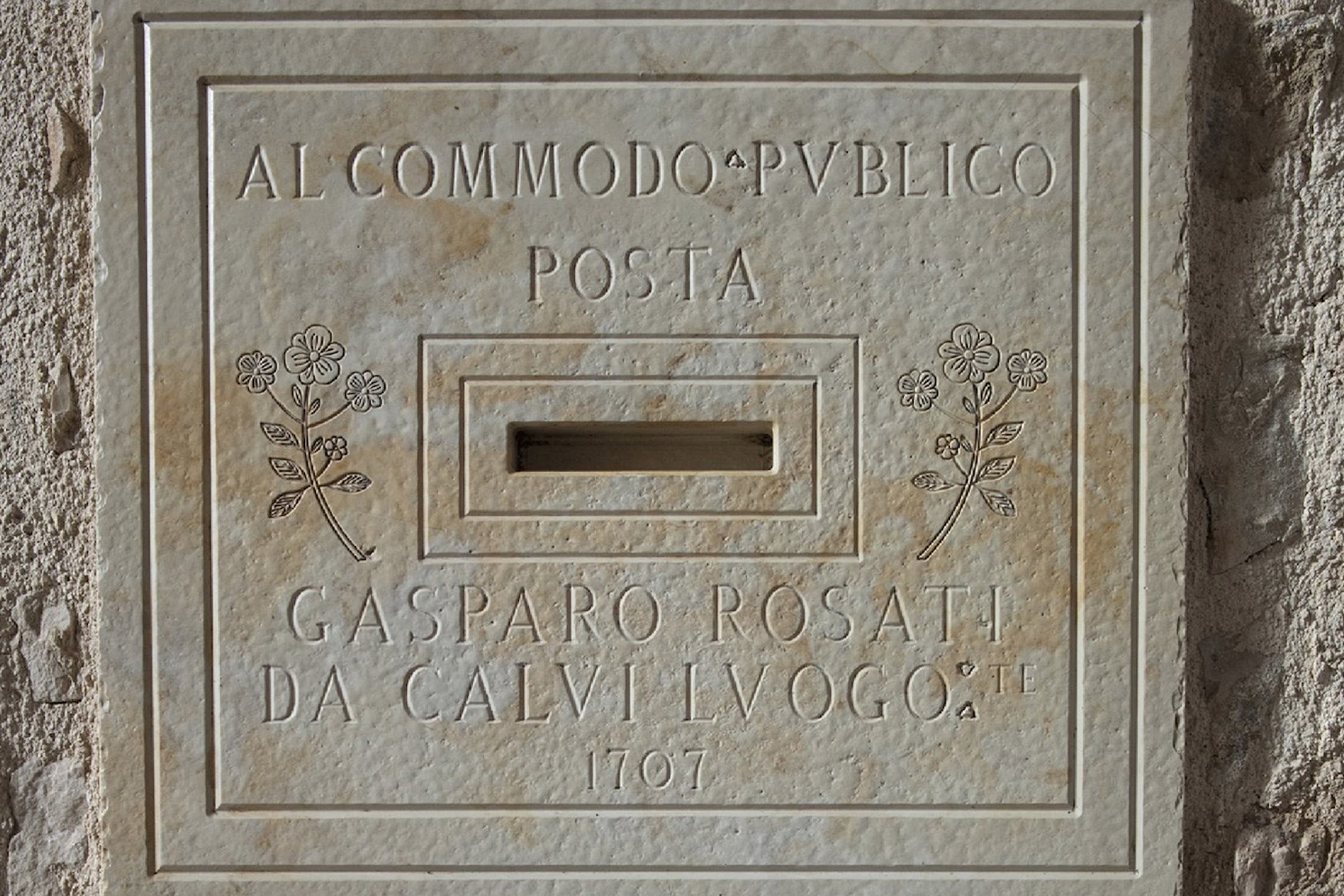
It is one of the first postal plates for letters of the Papal States dating back to 1707 and built under the judiciary of the Lieutenant of the post office Gaspare Rosati of Calvi dell’Umbria. The inscription engraved on the stone reports the following sentence: "AL COMMODO PUBLICO / POSTA / GASPARO ROSATI / DA CALVI LUOGO.(tenen)TE / 1707".
Under this plate, there is the box with metal shutter for the collection of the departing letters, whose expense or postal fee, before the introduction of the first papal stamps in 1852, is only paid by the recipient. Today's hole is a perfect reproduction of the original, flagship of Historical Museum of Posts and Telegraphs of Rome, where the precious relic arrived in 1932 thanks to the Provincial Directorate of Posts and Telegraphs of Perugia. In the past decades the relic loses its importance, because, away from its original location in the village, now it is damaged and almost forgotten in the Roman Museum.
The rediscovery of the historical importance of this relic artifact is due to the careful research investigation of a local historian Alberto Vannozzi, who also basing on his mother memories, Annunziata Poli, manages to reconstruct the events and the steps of this element up to the postal museum. After preliminary contacts with the local authorities and public institutions, and the specifications furnished by Alberto Vannozzi, the representatives of the ArcheoAmbiente Association and the City of Monteleone di Spoleto obtain a meeting with the representatives of the Museum, which ends with the return of the object, in order to give a correct appreciation and conservation on site of the historical and archaeological finds. The direction of the museum, in order not to deplete the precious heritage of this object, has acknowledged the aims put forward by Monteleone communities opting for the construction and donation of a copy of the same plate. On April 28th, 2007 with a grand ceremony chaired by the Mayor, the presence of regional, local authorities and citizens, the new letter box is replaced in the ancient site, replacing the original, moved away in the early 30s of the nineteenth century. Today is one of the major tourist attractions in the historic center.