

Description
In 1907 systematic excavations start, which identify an ancient necropolis of about forty graves.
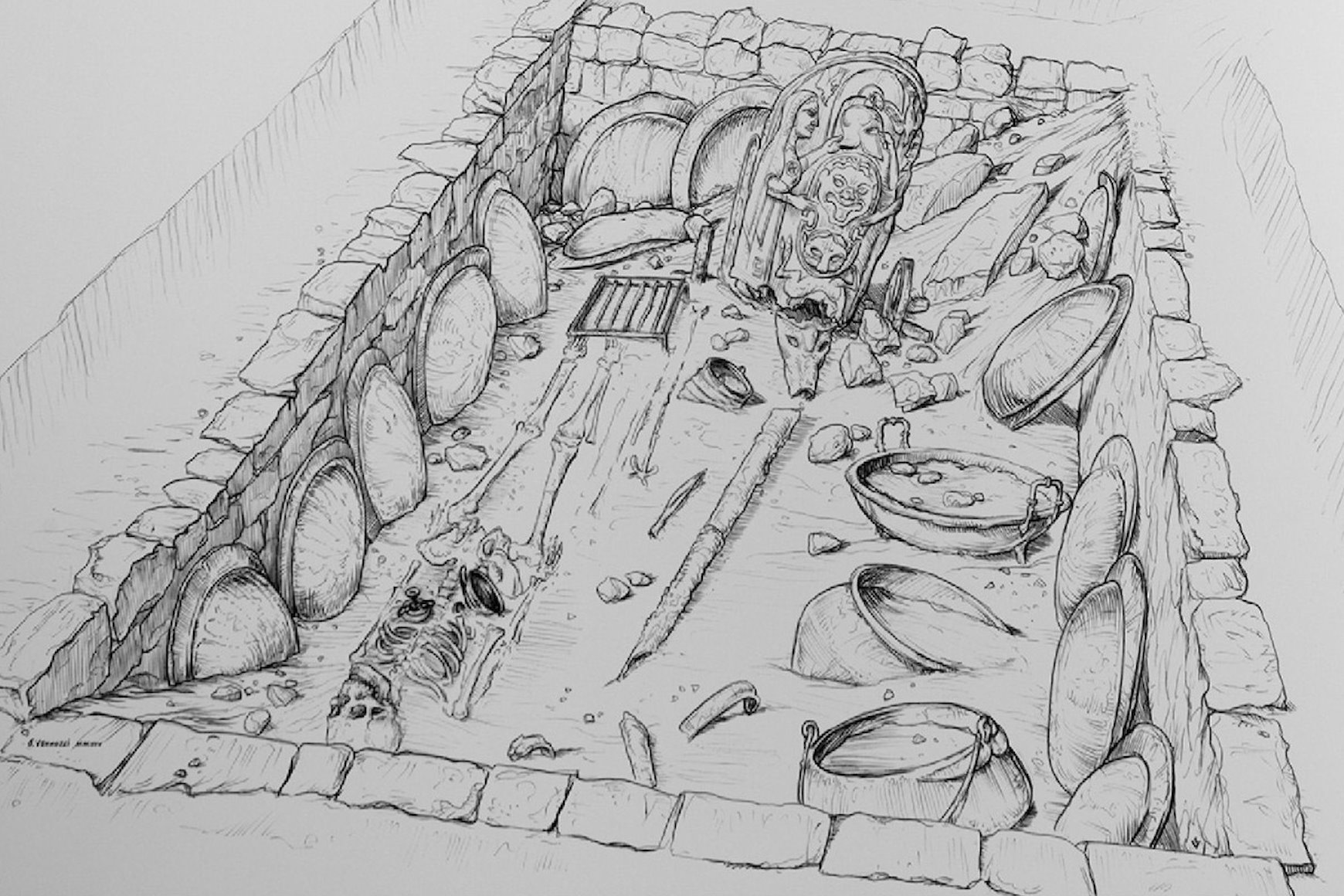
In 1902, at Colle del Capitano of Monteleone di Spoleto, during the works of adjustment in front of the farmhouse of Isidoro Vannozzi (currently open and used as a renowned agriturismo) a mound tomb is fortuitously discovered containing, among other things, a chariot (chariot parade pulled by two horses) of the mid VI century B.C.. Subsequently Vannozzi sells it to an antique dealer from Norcia, and then it has finally acquired by the US banker Morgan, who donates it to the Metropolitan Museum (1903). During the celebrations of the “Year of Etruscans” (1985) is made a copy of it by the school of the teacher Manzù and, at the lower parts of the complex of San Francesco, a Museum of Chariot is established, which reconstructs the context of the discovery and subsequent archaeological discoveries arising from the systematic excavations undertaken in 1907 (an important necropolis is discovered of at least forty-four tombs dated between the age of Bronze and the Age of Iron). In 1902 in the territory of Monteleone di Spoleto, in Colle del Capitano, during some refurbishment work of the area in front of the farmhouse of Isidoro Vannozzi (the brother Isidoro Vannozzi, called Isidoretto, and his future father in law, a certain Filippo di Biagio join these refurbishment works), a princely tumulus tomb is fortuitously discovered, containing important archaeological finds, including a fine chariot, or a parade chariot, intended to be pulled by a pair of horses. The subsequent sale mechanisms made by the colonist Isidoro Vannozzi to an antique dealer of Norcia are still to be cleared and, above all, the successive changes of ownership. Later on, this chariot is purchased by a US banker John Pierpont Morgan (1837-1913), famous collector of works of art, who donates it to the Metropolitan Museum of Art. From 1903 the Monteleone chariot is one of the most precious works of the Metropolitan collection. The chariot is in walnut wood and covered with gilded bronze plates (decorated with the embossed Achilles Stories) and with ivory plaques. Its origin has been widely debated and for a long time it is considered of Etruscan manufacture. According to recent studies, it has concluded the need to make some changes to the original assembly and to attribute the manufacturing to a Greek-Ionic artist immigrated to Etruria. In fact, from a stylistic point of view, the figures belong to that culture which is also found in products such as the “Loeb” tripods and the bronzes of Castel San Mariano, where Ionic experience joins indigenous Etruscan reasons.
The dating around the middle of the sixth century B.C is confirmed not only by the style of the work, but also in the examination of the remaining kit of the tomb of Colle del Capitano, where (among other findings) two Attic “kylikes” with mini figurations with black figures, dating back to the years around 560-550, are found. During the celebrations of the Etruscans (1985) a copy of natural grandeur of the work is made by the master of Art School Manzù. At the lower parts of the complex of San Francesco di Monteleone, a Museum of Chariot is therefore prepared, which reconstructs the context of discovery and the following archaeological discoveries. The first systematic excavations in the area of Colle del Capitano are undertaken in 1907 by the archaeologist Angelo Pasqui, following the protest made after the exposure of the chariot in the New York museum. The town returns over the years an important necropolis belonging to the transition period between the Bronze Age and the Iron Age, composed of at least forty-four cremation graves with cylindrical wells, of various sizes, containing cylindrical globular and biconical ossuaries. The house, which has been the theater of this heroic and fortunate discovery of the chariot, privately owned, can be visited today and is a renowned agriturismo.