

Description
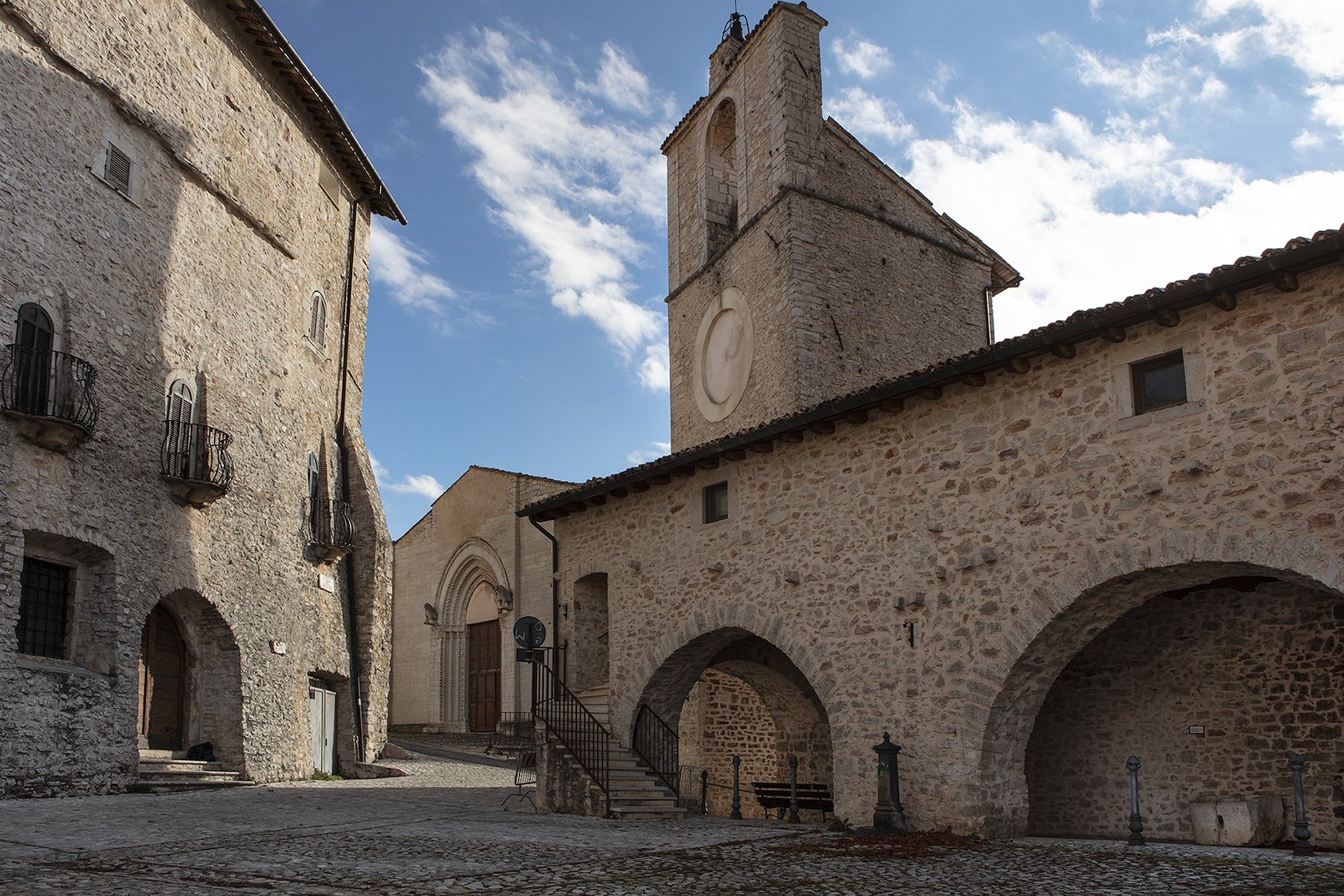
The Market Square has its origin in the second quarter of the sixteenth century, with the gradual shift of administrative and social life from the ancient feudal castle area further downstream. The election to the papacy of Pio IV (25th December 1559) is for the community of Monteleone di Spoleto the beginning of a golden age, as attested by a strong housing, economic and social recovery. The pretty little square, surrounded by the most important offices of the civil and ecclesiastical life, becomes the center of town life. Alongside there is a covered porch, beneath which the municipal cups (stone for the public measures guaranteed by the State), are aligned with a triple tank that allows the exact appreciation of the solids. The loggia, renovated in the late twentieth century, is linked to the square by two arches and shares with it an internal area, corresponding to the old plan. On the porch there are other fragments (a stone basin and a rectangular stone slab). Through the picturesque Clock Tower entrance, one can enter the oldest part of the village, which develops in a maze of alleys, in a typical medieval urban layout. At the walls, on the left, after the Civic Tower, which dominates the Renaissance village below, there is a lovely little square, better known as Market Square. Its origin and foundation must be sought in the second quarter of the sixteenth century, with the gradual shift of administrative and social life from the ancient feudal castle area further downstream, occupied by the church of Santa Maria Assunta (commonly known as Saint Francis), close to the Palazzo dei Priori (today part of "Carlo Innocenzi" Civic Theatre). With the election to the papacy of Pope Pio IV (25th December 1559), the Monteleone community begins a golden age, evidenced by a strong recovery in housing, economic and social affairs. The pacification of thorny political and territorial issues, that undermine the peace and economic town activity, lead to enhanced trade. The market has therefore its new epicenter in a square in a specially position above the walls and it is surrounded by the most important offices of the civil and ecclesiastical life. Beside the gate tower, a covered portico is erected, under which the municipal cups are aligned (the stones of public measures guaranteed by State). The triple tank of the cups allows the exact appreciation of solids, avoiding fraud of customers or dishonest merchants. The measure reference values vary from place to place, so much so that there is the need to have "tables" to compare weights and measures. Today the difficulty is both in knowing the exact value of an ancient unit of measurement and in determining the specific value in the geographic area of interest, since the same name can have different correspondences from area to area. For cereals the base, from which the various submultiples are derived, is the rubbio (also of oscillating value). The loggia, which is linked to the square with two arches, has an lower inner floor surface, corresponding to the oldest square plan. It is renovated in the Eighties of the Twentieth century, when the coverage and the low side door connecting to the tower are elevated. Under the porch there are other fragments, such as a rectangular stone tank and a stone slab.
Image gallery


