

Description
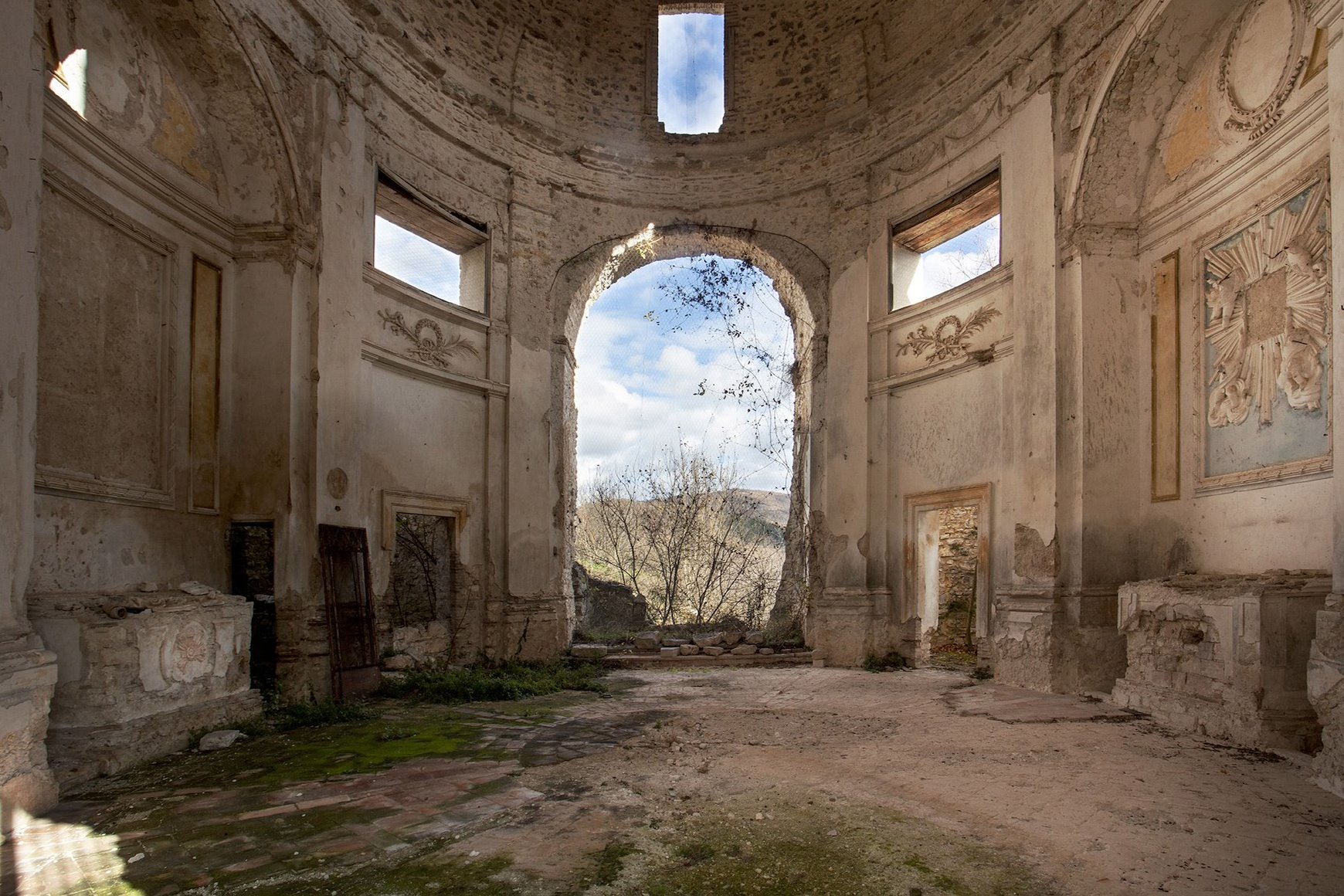
The ruins of the church still retain elegant rococo decorations and, in one monastic room there is the foundling wheel. The Monastery of Santa Caterina d’Alessandria is founded in Monteleone di Spoleto at the beginning of XIV century, behind the city walls (later included in the third wall). The religious sisters of Augustinian Rule are probably related to the community of the “Poor Clares” of Montefalco (1268-1308). Affected by the suppression of property clergy law of 1866, they move to Cascia. Their lands are sold and the facilities entrusted to the
Consortium of Landowners. The convent and the church are now in ruins. The plant, characterized by rectangular and elliptical shapes, is enlivened by niches and by a round tholobate. The inner stucco decorations are in an elegant Rococo style. In the rooms below there is still the foundling wheel, intended to accept the abandoned babies. There are reliefs with the emblem of the foundling wheel in the adjacent buildings, next to the ruins of the monastic structure, which demonstrate its relevance.
The Monastery of Santa Caterina d’Alessandria in Monteleone di Spoleto is founded in Monteleone di Spoleto at the beginning of XIV century, behind the city walls (later included in the third wall), next to monastic complex dedicated to Saint Agnes. Some documents of 1310 show the names of the nuns (Buccia di Romano, Margherita e figlia, Jacoma de Straccione, Paolina Compita de Scagno, madonna Annetta, madonna Filippa, madonna Rosanna di Tiburzio, Ceccarella) that, from the Monastery of St. Catherine in Norcia, move to Monteleone obtaining a land (with properties already belonging to St. Agnes) and the consent to establish their headquarters. The “Poor Clares”, following the Rule of St. Augustine, are probably linked to the community of Chiara of Montefalco (1268-1308), whose holiness in life produces the fervent enthusiasm of many followers and the sudden emergence of communities to her inspired. A few years later the nuns of Santa Caterina move temporarily to the Monastery of San Giovanni in Porta Spoletina, erected by Napoleone Tiberti of Monteleone, then return permanently in the original settlement at the beginning of XV century (Cardinal Eroli in 1465 during his visit complains the occupation of the Monastery of San Giovanni by private citizens and interrogates some witnesses who remind the last resident, Suor Margherita, who lived there about sixty years before). The monastic structures are destroyed by the earthquake of 1703 but immediately repaired. Affected by the suppression of the ecclesiastical property law of 1866, the nuns move to Cascia; the land is sold to individuals and the buildings entrusted to the Consortium of Landowners of Monteleone. The convent is now unfortunately in ruins and the church, whose recent restoration works date back to the years 2002-2004, is now only the shadow of the beautiful eighteenth-century building. The complex plant is externally of rectangular shape, with a protruding quadrangular apse, and internally elliptical (characterized by niches). A big oval drum with four windows surmount the walls. The façade is articulated by four pilasters and the portal have elements in stone, unfortunately lost. The side door on the left side preserves the wooden doors with shaped mirrors, with traces of metal parts now disappeared, while the stone lintel bears in relief a cross with trefoil terminals. Inside the beautiful stucco decorations are in an elegant taste Rococo style, with cherubs, garlands, floral frames and moldings. On the side altars a canvas is affixed on the left and a painting on the right, of which only the stucco frames remain (the second frame is decorated with an exuberant ornament with cherubs and light rays). The wooden grates at the top allow the religious clares to participate in the liturgy respecting the rules of strict separation with the faithful laics. One of the four little doors at the corners, on the right of the main door, is painted in trompe l'oeil, according to the illusionistic rules, thus respecting the symmetry of the distribution. The floor creates a frame with concentric rays. In the rooms below there is the wheel of foundling, that is, a cylindrical wooden mechanism with a swivel device, intended to accept abandoned infants (foundlings), which were left in anonymity to the nuns' care. The wheel, emblem of the martyrdom of Saint Catherine, is still observable on some buildings adjacent to the ruins of the monastery.. This symbol in relief on stone, made by durable texture and put in a well visible place, generally on the front door, attest the relevance of the property at the monastery
Image gallery

