

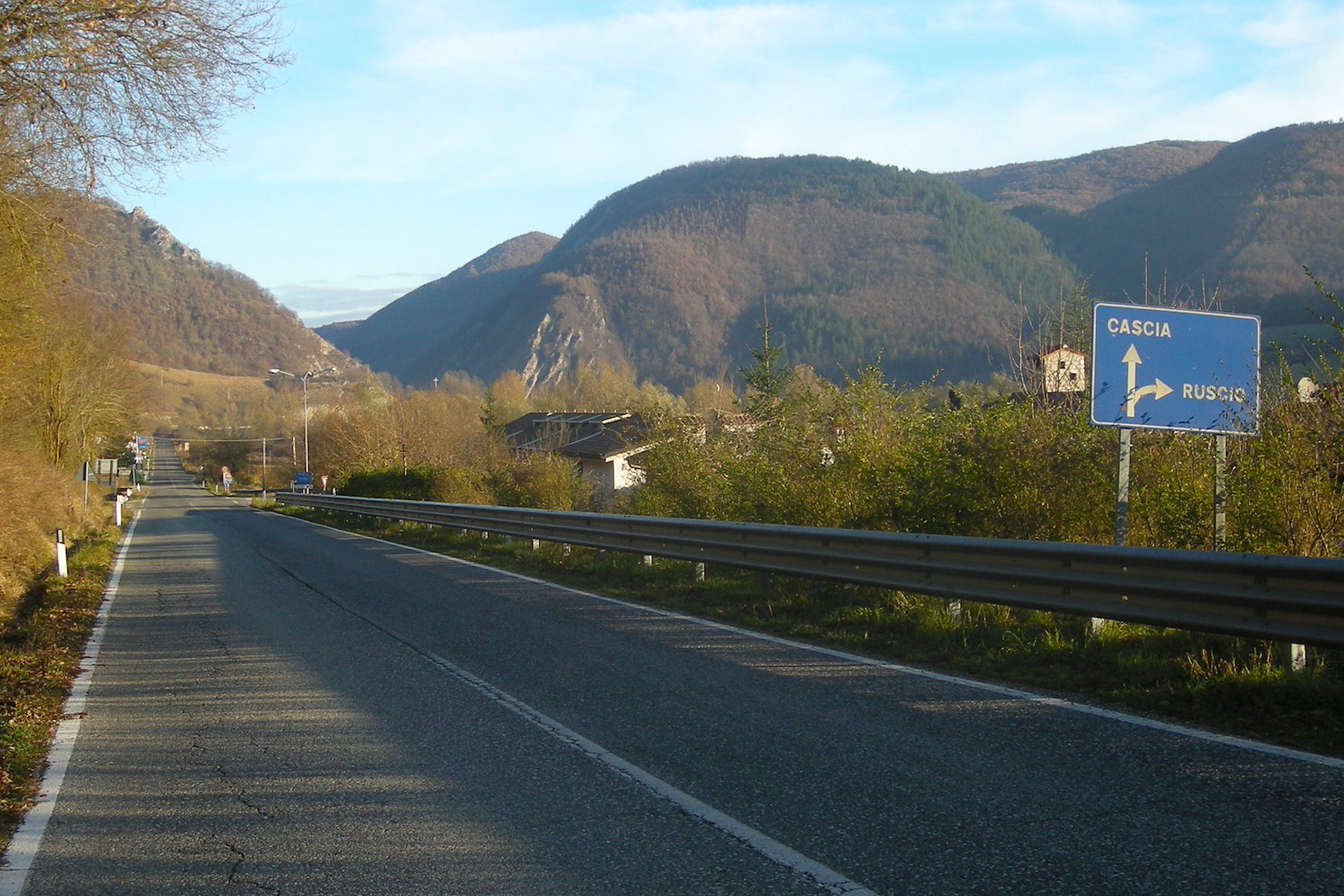
Description
The provincial road n. 195, known as "Casciana" because it allows the passage between Casciano and Leonessano and, therefore, between the province of Rieti and that of Perugia, is a work of road construction carried out in the second half of the nineteenth century, using, where possible, traits of previous and oldest tracks. The road follows a picturesque route altitude, covering a total length of 22.4 km. In the late nineteenth century it begins also to be noted in the regional tourist guides and postcards, depicting the admirable mountain route, with the realization of real rocky pinnacles, or "rocks" of suggestive visual impact. In the Second World War the road becomes a theater of military actions. Then the Municipal administration of Monteleone di Spoleto requests state funding for the reconstruction of the Ponte delle Ferriere, undermined and destroyed by the Germans during their retreat.
The provincial road n. 195, known as "Casciana" because it allows the passage between Casciano and Leonessano and, therefore, between the province of Rieti and that of Perugia, is a work of road construction carried out in the second half of the nineteenth century, using, where possible, traits of previous and oldest tracks. The road follows a fascinating route, especially towards Monteleone, meeting different minor centers between Cascia and Leonessa and covering a total length of 22.4 km. The history of this track dates back to the discussions in the Chamber of Deputies held on June 26th, 1861, when "the city councils of Cascia, Poggiodomo, Monteleone and Leonessa (Spoleto) make application for the construction of a road from Rieti to Cascia, in order to link Rome to Marche provinces". This construction continues with various sections and for several years between 1861 and 1870, so that, for lack of funds, the stretch of Casciana in Monteleone, ranging from Forca di Ocosce across the village of Ruscio to Leonessa, is still in construction and is subject of debate for more funding during 1873-74 session. The following year a "NOTICE OF AUCTION on March 12th, 1875 at 11 AM, approved by the General Management for bridges and roads. The Provincial Deputation approves the project prepared by the engineers, for the construction of the Casciana road to Monteleone, from the village of Ponte delle Ferriere to the village of Ruscio, of a length of 2078 61 meters of a total amount of Lire 50.841 43, providing the procurement of the work". Due to financial problems, the works slows down early. A significant boost of the works for the track to Leonessa is finally given by State law (and its contributions) on 23rd July 1881 n. 333, which provides for the construction of 6201 km of national roads well-divided as it follows: 1450 km to the North, 880 km to the Center, 2778 km to the South, 1093 km in the Islands (with a contribution of the state by free grants amounting to 50% of the planned budget for each implementation). The list of roads according to that Law, to be built ex novo or to be completed, includes the number 195 (which later became one of the Provincial road) to be finished, in the trunk that goes from Forca di Ocosce in Ruscio, for a distance of Km. 7,500, with a total cost now risen to L. 160,000 to be divided and equally charged by the Government and the Province of Perugia. In the late nineteenth century and in the new century, the road, now over and fastened to Leonessa (RI), is noted in the regional tourist guides and postcards, depicting admirable cuts in the mountain after the Ponte delle Ferriere, with the realization of real rocky pinnacles, or "rocks" of suggestive visual impact. A geological guide describes the nature "along the last five or six kilometers of the carriage road from Cascia to Monteleone di Spoleto there is a narrow Jurassic limestone anticline similar to those of Leonessa", while a tourist booklet of 1903 mentions it as a new and "convenient road that runs through the gorges of the Corno at eight or ten meters away from the ancient ironworks joining Monteleone on one side with Cascia and Valnerina, and on the other side with Leonessa-Piediluco and Terni". In 1912 the road is affected by the opening of a major automotive service connection between Cascia, Leonessa, Morro Reatino and Terni, with a stop at the foot of Monteleone di Spoleto, in the hamlet of Ruscio. The Second World War leaves its traces and this road becomes the scene of several war actions between 1943 and the spring of 1944. A survey of the Prefecture of Perugia made on August 1944 around the request of the municipalities for the damages suffered to the road unveils the reconstruction request for the Ferriere Bridge, on the road to Cascia, undermined and destroyed by the Germans during their retreat. A further report of damage to public property starts from the Prefecture in the second half of March 1946. Some Municipalities, such as Città di Castello, Collazzone, Lisciano Niccone, Monteleone di Spoleto, Paciano, Poggiodomo and Scheggino, declare that they have not suffered any damages to their holdings.
Image gallery


