

Description
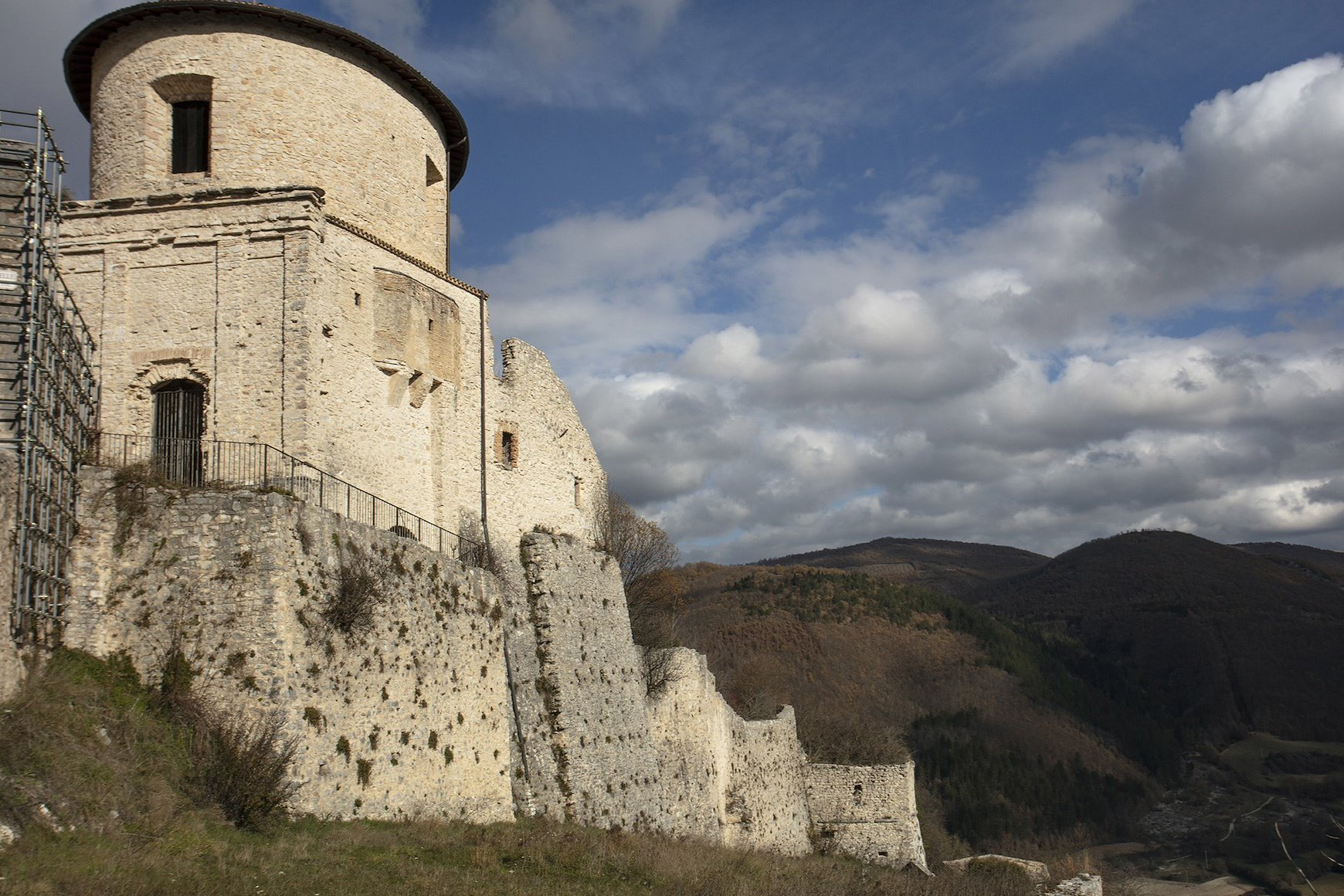
An important defensive expansion is operated in 1463-65 by the famous Lombard master Beltramo di Martino from Varese. The Bulwark of the Annunziata, born to control the Corno River and the way to Cascia, takes its name from the ruins crumbling of the nearby urban church of Santissima Annunziata. It is one of eight bastions belonging to high walls with six towers that surround completely the village of Monteleone di Spoleto, born in a strategic position of great importance, as a place of transit and border with the Kingdom of Naples. The restoration and the expansion of the castle walls are made around 1463-65, with the construction of the defenses built according to new discoveries of fortified architecture against the firearms. These military engineering works bear the signature of a known Lombard master Beltramo di Martino from Varese (or Beltramo from Como or Bormio), a well-known entrepreneur and hydraulic architect, civil and military operating in central Italy in the fifteenth century active, among other things, in Rome and in the Papal States.
Monteleone Spoleto is closed and surrounded by a long circuit of high walls composed of six towers and strengthened, in the most sensitive areas, by eight bastions. These defenses, protruding from the walls and in control of the fortification of the access doors, are built during the second half of the fifteenth century, when many internal and external quarrels exacerbate between Monteleone di Spoleto and its neighbors. The center, located in a border and in an important point of transit with the Kingdom of Naples, is constantly guarded by armed troops and surrounded by massive defenses. In this climate of uncertainty, feeling threatened, the city of Spoleto send to Monteleone a new mayor, the Spoletine Piersanto Saccoccio Cecili, with a stable garrison of seventy men; he also restores the fortress, with a new tower, and sends some suspicious families to Spoleto. Starting from 1464 there are many clashes for the boundaries between Monteleone and the nearby Cascia. An expedition of the inhabitants of Cascia is rejected by Monteleone during the vacant power following the death of Pio II (the inhabitants of Monteleone, come out from the walls, kill the enemy and repel them). The following year, the new Pope Paul II order the reconstruction of the castle of Cascia, in order to rearrange the border places, and entrusts the Government of Monteleone castle to the papal Commissioner Raffaele of Mantua. This event is particularly pleasing to Monteleone inhabitants, who write to the Priors of the city of Spoleto, invoking their benevolent protection and confirming their devotion to them. Between 1463 and 1465 the restoration and extension of the castle walls are made, with the creation of ramparts built according to new architectural discoveries against firearms. These engineering works are due to a well-known Lombard master, Beltramo di Martino from Varese, also known as Beltrando (from Como or from Bormio) or Master Beltramo Lombardo, a well-known entrepreneur and hydraulic architect, a civil and military of Lombard origin, who operates in central Italy in the fifteenth century. Among the foremost construction companies he is active in Rome and in the Papal States under Pope Nicolò V (1447-1455) in the yards of the Rock of Orvieto (1451) and in the partial reconstruction of the new Basilica of St. Peter; he always works in Castel Sant'Angelo in Rome under Pius II (1458-1464), in the aqueduct of the virgin for Paul II (1464-1671) and in the fortress of Viterbo (in the years between 1444 and 1469). With a strong capital and with his own army of workers, as well as limestone and kilns for the production of bricks In Rome, he realizes in few years an income of 30,000 ducats a year only thanks to the costs of supplies for the construction industry. He is more remembered for graphic testimony than for his works, now largely destroyed or completely altered. A high technical specialized group of work with Beltramo from Varese, composed by his nephew Giovanni Piccinino, Pietro di Giovanni and Giorgio from Varese, that in the field of military architecture of the time stands in for the reconstruction or construction of the new defensive systems: in addition to the fortification of Castel Sant'Angelo, it must be remembered also Soldano tower and the tower of Nicholas V to the Capitol, the fortresses of Ostia, Santa Marinella and Tivoli; the castles of Cascia (1465), Arquata and Monteleone di Spoleto and even in Castel Nuovo in Naples. Some notes of payment date back to the years 1468-69, made by the Pontifical State in favor of Beltramo and of such a master Francesco, precisely in regard to the "factories of the Cassia, Arquata Castles, Monteleone." A few years later there are news of further "expenses made by Perugia regarding fortresses in that place that needs economic helps, such as Monteleone.” Different pieces of firearm or artillery are also famous, in part still preserved in the half of the nineteenth century in the underground rooms in San Francesco, already used as the municipal armory. With regard to the admirable architectural polygonal defenses, which strike the visitor at first sight, as Corona writes: "starting from the east there is the bulwark of Annunziata and continuing upwards, climbed over the side of Pago, there is the bastion of Macchia, then a square tower and another bulwark to the Fountain Gate; from here there is a path leading to one of the bulwarks of the village door, near which two towers rise; then the walls fall downwards and are adorned by a round tower and lower reach the bastion of the door of the Nuns, perhaps the most beautiful; further down, over the little church of Madonna della Quercia, there is another bastion, the highest of all, and after touching another tower toward Catòsa bulwark it rejoins to the Annunciation ". These defenses do not however save the castle and the village of Monteleone from the further threats that persist throughout the course of the fifteenth century thanks to the Italian political and military instability. The territory of the Valnerina becomes again theatre of conflicts for bandits of the Ghibelline part and as it already happened in the period between 1474-1475 and during the rebellion of 1478. In the latter year, Sixtus IV brings together the territory under a single administration, by creating the Governor in Norcia, with direct control over the territories of Monteleone, Cascia, Norcia, Cerreto and Visso. With the election of Innocent VIII in 1494, who is against the King of Naples, the territory of Monteleone is again subject to the continuous raids and to the encroachments of the neighboring towns. In 1494 the struggle between Alessandro VI and the party of the Colonna-Varano-Savelli starts again, mainly because of the hopes of the Savelli related to the descent of Charles VIII in Italy. Once again, the castles of the Valnerina pay for it, subjected to the mercenary companies, amongst which that of the 400 mercenaries in command of Camillo and Paolo Vitelli of Citta di Castello. Cascia pays the required size, while Monteleone, being well equipped, try the resistance; the siege ends a few days later with the surrender and the looting of the town. The Bulwark of the Annunziata, set at the bottom of the street and set to control the river Corn and the way to Cascia, takes its name from the crumbling ruins, but still visible, of the nearby urban Church of the Annunziata, which stood in one of the most charming places in the village, where one can admire a landscape that ranges from the Gola delle Ferriere to the summit of Terminillo Mount.