

Description
The Church of Santa Maria or Madonna dell'Assunta in Monteleone di Spoleto is commonly known as the Church of San Francesco due to the settlement of the Franciscans (ca. 1280). The first nucleus dates from 1282-1285, with alterations in subsequent centuries and radical transformations after the earthquake of 1703.
Between 1395 and 1398 two superimposed churches were created: rich in artistic testimonies is the upper church, with two naves and a portal with twisted columns and figured reliefs; the choir of the lower church is adorned with a vivid cycle of late Gothic frescoes, while in an adjacent room (originally the nave) some painted arcosolia have come to light. The upper cloister preserves a collection of epigraphic and sculptural fragments from the Roman, medieval and modern periods. A notable collection of sacred art (painting and sculpture) is instead displayed in the sacristy.
The worship areas belong to the F.E.C., while the lower cloister and part of the conventual rooms are municipal property, home to events and the Museo della Biga.
The main entrance to the Church of San Francesco in Monteleone di Spoleto opens onto the square of the same name, to the right of the gate called dell'Orologio. The monumental complex is perhaps the most striking and evocative work for its complexity of development, art, and faith. It is a book of stories, Saints and symbols to be scrutinized and read carefully. Its main pivot is today's Church of San Francesco, erected during the 14th century on a previous 12th-century Benedictine oratory. The original title is actually that of Santa Maria or Madonna dell'Assunta (Santa Maria di Monteleone is mentioned in a codex in 1393), but it is commonly known by the name of the poor man of Assisi since around 1280, when the first Franciscans settled there. In fact, until the suppression of the convent, the Franciscan order in Monteleone always used in every official act a seal bearing the emblem of the Order surmounted by the image of the Assunta taken up to heaven, with the initials S(anctae) M(ariae).
The first nucleus of construction dates back to the years 1282-1285 during the pontificate of Pope Martino IV. The church, again altered in the 15th century, was restored and radically resized following the ruinous earthquake of January 1703. The 14th-century church was, in fact, of much more slender proportions than the current one, as moreover appears in the external wall, corresponding to the apsidal area. The floor was raised between 1395 and 1398, with a lower round arch vault, reducing by a third the height of the original church, which was accessed from the ogival door on the right side, and creating a new worship space in the lower part. The effects of this division are clearly visible in the internal floor of the church, which cuts the fresco with the Crucifixion on the left wall, further mutilated later by the subsequent opening of a modern door, which leads to the upper order of the cloister.
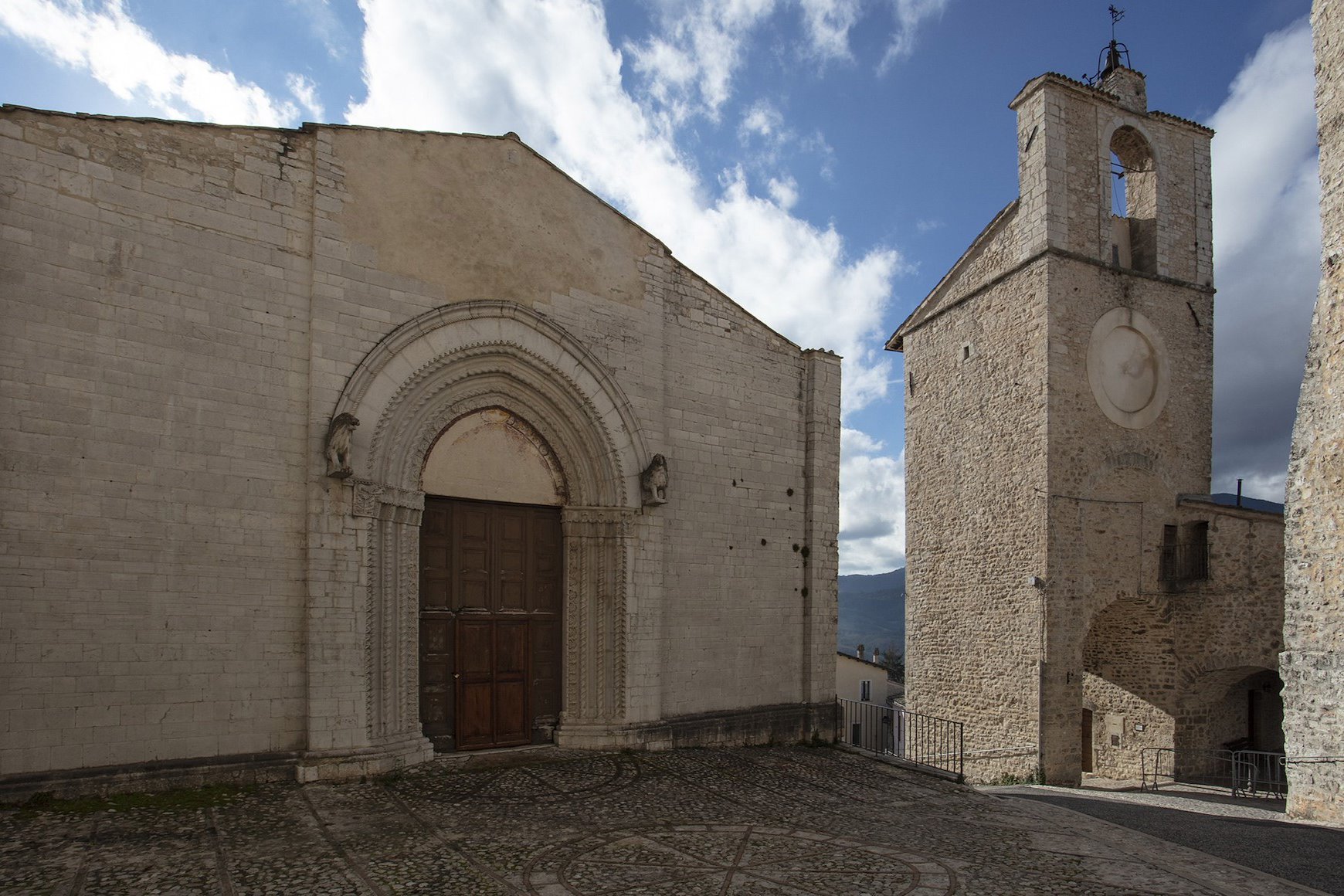
The main facade (facing North), damaged by various earthquakes and partially truncated in the upper part of the original crowning, is adorned with an ogival portal of clear Roman-Gothic taste. Enriched by a bundle of three twisted columns and reliefs of vivid naturalistic flavor with animals, human figures and angels, it is the work of Lombard masters. The last two bands that decorate the jambs, resting on two stone lions, are characterized by numerous figures reproducing flowers, fruits, animals, Saints, angels, dragons, sun and moon. In the upper lunette is a 15th-century fresco, now fading, depicting a Madonna with Child between Saints Francesco and Nicola. On the sides of the external facing, in particular light conditions, traces of devotional graffiti and a cross are visible. On the right flank the powerful buttresses with sculpted finials give the building the character of a fortified place, also accentuated by its position and proximity to the castle gate, along the walls.
The interior has two naves, divided by stone pillars. The larger one is decorated with the beautiful wooden ceiling painted by Giuseppe Frigerio da Norcia (1760); the smaller one is covered with cross vaults and ribs. Of the internal wall decoration, numerous fresco cycles remain, often juxtaposed with each other (created between the 14th and 16th centuries), unfortunately partly damaged by numerous alterations. Among these are depicted: San Giuliano, Santa Maria Maddalena, San Giorgio, Santa Caterina d'Alessandria, Maria Maddalena, Madonna with Child, Sant'Ilarione (?), a Dormitio Virginis, a Crucifixion, a Jesus High Priest. A reminder of one of the patronage altars of the most important families of Monteleone, later dismantled, is an oil canvas of quadrangular shape depicting four Saints facing the altar of the Most Holy Sacrament, which in a cartouche depicted at the foot of the antependium, with the coat of arms of the Rubeis family, recalls its restoration under the care of Reverend D. Giovanni Antonio De Rubeis. The fake letter bears the following inscription: "SVB LEONE X° ERECTVM / SVB CLEM(ent)E NON° RESTA(uratu)M / ET AVCTVM ÆRE. R. D. / IOAN(ni)S ANT(on)Y. DE RUBEIS." meaning "This altar erected under Leone X was restored under Clemente IX and enlarged by reverend Don Giovanni Antonio Rossi". Twelve canvases depicting the Savior and the apostles adorn the right wall of the large nave; a long marble inscription, placed between San Paolo and Sant'Andrea, attests to the gift made to the church in 1630 by Amico Sinibaldi, noble Roman knight (but direct descendant of the Sinibaldi of Monteleone). Also of interest are the 15th-century wooden Crucifix, placed above the altar of the same name, and the wooden choir. On the walls of the same nave are placed some 17th-18th century altars, with contemporary canvases, including a Madonna with Child, San Francesco di Paola and San Gaetano da Thiene and an Annunciation attributed to Agostino Masucci from 1723, coming from the Church of San Nicola. Also present is a 16th-century organ, with case and choir loft decorated in the 18th century. Among the holy water fonts is one that bears the Greek symbol of the Tau, last letter of the Hebrew alphabet, which represents the fulfillment of the entire revealed word of God.
From the door that cuts the fresco with the Crucifixion, one accesses the upper cloister, once covered with cross vaults (of which the springer points remain). The nine tempera lunettes (excluding the first), created in the first half of the 18th century, relate to the life of San Francesco. At the foot of these, and along the entire wall of the corridor, is grouped in the manner of an antiquarium a small collection of epigraphic and sculptural fragments from the Roman, medieval and modern periods, commissioned by parish priest Don Angelo Corona. Part of the medieval architectural material in fact comes from the parish church, while a headless female statue was recovered from the church of Sant'Erasmo in Trivio. Here is also the Roman funerary inscription of Sesto Vettuleno, found decades ago at Forca di Usigni, in the municipality of Poggiodomo, and bearing the following text: "SEX VETTVLENVS. P. F. GRAGVS / VETTVLENA. SEX. F. VXOR".
In the sacristy is housed a small but notable collection of sacred art, which includes a Madonna with Child from Castelvecchio, a wooden sculpture from the 13th century. From the upper cloister one accesses the lower one, rich in pictorial fragments dating between the 14th and 15th centuries. Here, next to an arcosolium with Madonna enthroned among Saints, is a rare fresco depicting the subdivision of the Universe according to the Ptolemaic system with Earth at the center (which contains within itself the Infernus), surrounded by various elements, in hierarchical scale according to the beliefs of the time.
From a corner door one instead accesses the choir of the lower Church, dedicated to Antonio di Padova. Vivid frescoes are preserved, predominantly of Franciscan subject matter and datable between the very last years of the 14th and the beginning of the 15th century, which constitute an interesting testimony of the painting of southern Umbria. The central room, corresponding to the upper nave, had various uses, including that of burial place and then theater. On the left wall some richly painted arcosolia have come to light. The church, occasionally open for worship, is owned by the Fondo Edifici di Culto (F.E.C.) of the Ministry of the Interior. The lower cloister and part of the conventual rooms, municipally owned, are often the site of art exhibitions, events and cultural meetings, as well as home to the Museo della Biga.
Image gallery


